thermoking:contentType/customerStory
Published: January 05, 2026
Klinge’s CBU-30 Blast Freezer helps power a sustainable tuna industry on remote St. Helena
Find out how Klinge’s self-contained, modular CBU-30 freezer helps power a sustainable tuna industry on remote St. Helena.
Quick Facts
When Saints Tuna Corporation set out to revive commercial fishing on one of the world’s most remote islands, they turned to Klinge, a portfolio of Thermo King and part of global climate innovator Trane Technologies, for a reliable, energy-efficient freezing solution.
Challenge: Building a modern fishery on one of the world’s most remote islands
For generations, fishing has been a way of life on St. Helena, an isolated volcanic island in the South Atlantic Ocean. But turning that local tradition into a viable export business posed enormous challenges.
When Saints Tuna Corporation secured a long-term contract with the island’s government to revive and operate the local fish processing facility, they faced a challenging task: the existing factory was more than two decades old and largely inoperable. “We had to refurbish the plant from the ground up,” explained Johan Beizuidenhout, executive director of Saints Tuna Corporation. “The old ammonia system was broken, and because of our location and limited resources, a permanent installation wasn’t practical. We needed a modular, efficient and reliable freezing solution.”
Operating on St. Helena means most of Saints Tuna’s parts and shipments must travel by sea, often taking six weeks or more to arrive. Mechanical support is limited, and electricity is generated entirely by diesel, making energy costs exceptionally high. Planning ahead is not optional. “Maintenance here has to run two months ahead of schedule,” said Beizuidenhout. “You have to have your finger on the pulse at all times.”
To succeed, Saints Tuna needed a way to efficiently freeze and preserve their catch for export while lessening energy use and promoting reliability in a remote environment.
Solution: Compact power and reliability with Klinge’s CBU-30
Saints Tuna found their ideal fit in the Klinge CBU-30 Containerized Blast Freezer, a self-contained, modular system designed for ultra-low-temperature performance and ease of deployment.
The CBU-30 is designed for freezing cargo from -20ºC to -60ºC (-4ºF to -76ºF), while maintaining a compact footprint by using just 1.5 meters of container space. “I had looked at options in South Africa, but those units were enormous and much more costly,” said Beizuidenhout. “In a 12-meter container, I still have more than ten meters of usable internal volume and can freeze five tons per day.”
Installation was straightforward despite the island’s infrastructure constraints. The blast freezer was positioned within the refurbished plant building, with limited structural modification. “It really was a plug-and-play setup,” Beizuidenhout said. “We broke through a wall, slid the unit in, sealed the space and were operational. The simplicity of it is brilliant.”
Klinge’s support team stayed actively engaged throughout setup and operation. “Even during COVID when travel wasn’t possible, their after-sales service was fantastic,” Beizuidenhout shared. “I could WhatsApp them anytime and get immediate help – even from the other side of the world. Knowing that support is there gives me a lot of confidence.”
Results: Unlocking a sustainable future for St. Helena’s tuna industry
Before Saints Tuna’s arrival and adoption of the CBU-30, the island’s fish processing plant was inactive, and the local industry relied heavily on external support to maintain limited operations. After the installation of the modular freezing system, the island now looks like it has a pathway to self-sustaining exports.
“The blast freezer unlocked our ability to create a functioning export industry,” said Beizuidenhout. “For the first time, we can take care of our product in a way that lets us compete internationally on quality and performance.”
The CBU-30’s energy efficiency and modular scalability have also helped to give the company flexibility to grow responsibly. Saints Tuna can freeze only what is needed, lessening energy use in an area where power is both expensive and limited.
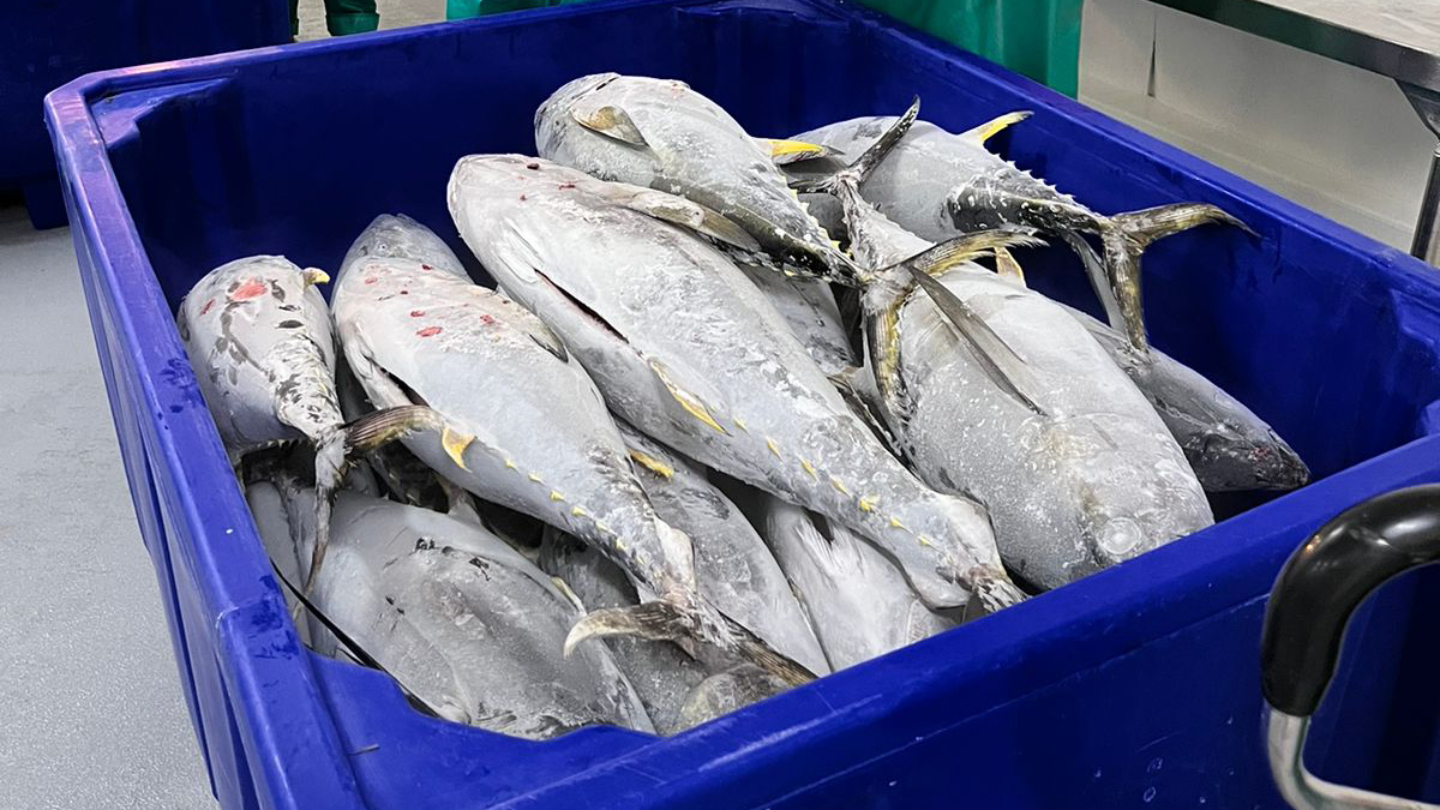
As of today, Saints Tuna has exported several containers of frozen tuna, demonstrating the feasibility of a sustainable fishery on an island in such a remote part of the world. The next step is expansion. “In a perfect scenario, I’d like to have four of these blast freezers,” said Beizuidenhout. “That would give us 20 tons of daily capacity and built-in redundancy for back-up coverage or scale up based on catch volume. We could process multiple species at once and provide more opportunities for local fishermen.”
“This solution has changed everything,” said Beizuidenhout. “Before, there was no capacity, no real industry. Now, we can see a future here – a proper, profitable, sustainable fishery built on reliable technology.”